Posts

Showing posts with the label new law

RES Market in Poland: Biomass and Biogas New Favorites - Wind and PV Seem Doomed

Image
The biggest development in the renewable energy prospective market in Poland is the new amendment in the Sejm, which has passed the committee and appears to be sailing for rapid rubber-stamping by the rest of the government in Warsaw. The single biggest characteristic of the law is the emergence of separate technology "baskets" for renewable energy auctions. The Polish Government figured out that it can control the mix of technologies by setting the size of the baskets as well as the reference prices (maximum allowed support in the form of a contract for the difference). Regardless of any other developments, it appears that this procedure will be used to skew the support away from PV and wind to biogas and biomass. The characteristic being used to "make the cut" is the stability and reliability of the renewable energy source. The intermittent nature of PV and wind have led the Polish Government to put them into a less desirable category in baskets which can be l...

PERVERSE INCENTIVES AND ENERGY PROBLEMS

Image
We live in a strange time and place. Electricity in Poland is much cheaper than it was a few years ago, but the experts are projecting power shortages in the near future. The rules of supply and demand seem suspended by the regulatory and political situation. The low price of electricity in Poland is stopping new construction and investment for multiple possible sources. Polish government officials do not want us to follow the road of Germany and develop a higher percent of renewables. They say it is too expensive and unreliable. Yet German electricity is cheaper than Polish power and has far, far fewer outages. The Polish Government objects to adding too much to the price of electricity to support renewable energy, but proposes to continue to use most of the support for the existing production of electricity with only a small partial switch to biomass to make it "green." This does not create any new electricity and detailed studies show that it is 100% transferred to...

Reality Hits Polish Government Plans for Renewable Energy

Image
The Polish law on renewable energy has been a moving target for years. Originally, the law was deliberately delayed to allow the state-owned energy companies to keep receiving support which the European Commission would have stopped if the new law had been notified under the treaty. Now the delays are being triggered by the new government's efforts to amend the program on the fly. The government has convinced itself that what RES capacity is already done and more co-firing will be all that we need. Some additional biogas plant construction (actually a lot in real terms) is strongly supported in their mix. But the classic RES technologies are on their black list. They have been completely persuaded by the coal lobby that these technologies are too unreliable to be major parts of the energy mix. The factual basis for their assumptions is being broadly challenged by the RES sector. Poland will not meet the 2020 target without a serious program that includes the full mix of RES ...

What Will the European Commission Decisions on Green Certificates and the New Polish RES System Mean?

Image
On March 16, 2016, a conference on the meaning of the European Commission's new decision on Polish green certificates as state aid and the prospects for its decision on the new RES law will be held in Warsaw. Readers of this blog already know the issues and the possible consequences. The conference will feature the leaders in the RES sector, the complainant in the case before the Commission, the Polish Government (invited), and the major utilities in Poland (invited). THE IMPACT OF STATE AID ENFORCEMENT ON POLISH RENEWABLE ENERGY ___________________________ An In-Depth Seminar on the Legal and Practical Problems Facing Polish Energy March 16, 2016   Hilton Hotel Warsaw The lack of notification and approval of the existing Green Certificate program has caused the European Commission to investigate its lawfulness and compatibility with the EU Treaty. See Case SA 37244. Major parts of the support system (co-firing ...

New Year: SOS?

Image
The year is ending with the new Polish Government trying to re-arrange the deck chairs on the Titanic which is Polish energy policy. The Law and Justice party seems confused between its election campaign rhetoric and the realities of the situation it now faces. As the deck is vanishing under the encroaching sea, the politicians gather on the fantail making speeches about the ship's seaworthiness. Almost all elements of the proposed path to energy security are fraught with bogus assumptions, bad information and a special kind of Polish naiivity. Shale gas- when there is a major rise in  oil and gas prices worldwide and the government gets out of the way, this might be possible. Until then, it is a dead-end street in Poland. The type of policies it would take to really jump start shale gas here (where it is in deep formations and quite expensive to develop) seem implausible in the context of Polish politics. Now more than ever.....  This day, if it ever comes, also depen...

Re-Writing the Polish RES Law

Image
It will be necessary to re-write the Polish Renewable Energy Law that was adopted in April 2015 to meet the objections of the European Commission. Major provisions that will have to be changed to meet the Commission's consistent position in approving other certificate schemes include the following: 1. Prevention of Over-Accumulation :  This will require that certificates be used in a fixed time period. This could theoretically wipe out almost all of the accumulated certificates now being held. Note: the old hydro certificates will be null and void in any event under the depreciation rule. The co-firing certificates will otherwise likely be valued at 50% or less, even if they are allowed to accumulate. 2. Correction coefficients : The value of the certificates will have to be adjusted by the cost of production of electricity for each technology. The adjustment must assure that there is no over-compensation of technologies such as co-firing. Arguably, only the technologies in...

How We Got Here is Not as Important as Where We Are: RES in Poland

Image
We finally, it appears at least, have a new law on renewable energy in Poland. The process has been ugly, ignorant and often deceitful. Like all efforts at government control of economic activity, it will be full of unintended consequences. The day of reckoning in Brussels has been postponed until now, but not canceled.  The two biggest issues facing the country in RES are first the transition from one support system to another (understanding that many facilities will continue to have Green Certificates, that the quota system remains in place,  and that auctions in 2016 or 2017 may do relatively little to affect the mix of RES in 2020). This issue also has the enormous problem of revolving around unnotified unlawful state aid in the form of the certificates. This year, Poland will likely get the final notice from the Commission that this has to stop, meaning that another piece of legislation trying to retroactively adjust the current system to EU law will be required. This...

Delay in Final Approval of the RES Law in Poland: Impossible to Conduct Auction in 2016

Image
Increasingly it appears that the new law on renewable energy will not be in effect until substantially later than the latest government prediction. This is no surprise, since the government has been promising a new law within six months for the last two years.  Final approval by both houses of Parliament will go over into 2015, an election year, which will make final consensus difficult. The final figures for renewable energy production and investment for 2014 will reflect the uncertainty and doubts in the market. Perhaps the fact that investors are lined up to invest in Poland in this sector (perhaps as in no other sector) and are only blocked by the government, will leak into the elections themselves. The fact that electricity bills for everyone are higher than legally permitted by the inclusion of subsidies for co-firing and old hydro would seem to be a political liability. Much of this support does nothing to help compliance with the 2020 target, since it is either superfl...

Polish Biogas Association Comments on New Draft Law

Image
PBA filed detailed comments on the new law, stressing changes that do not require higher subsidies, but improve biogas productivity. More waste substrates can be handled to reduce the impact of their management on consumers. Green Certificates should continue for small projects that allow direct sales of electricity, again saving consumers money. All types of biogas should benefit the same from regulatory procedural incentives, with support levels adjusted by cost of production as required by the EU state aid rules. These issues have been raised for the four years that the draft legislation has been circulating. Since biogas remains a major part of the national plan to meet the 2020 EU renewable energy mandate, as well as providing many additional benefits, the revisions should be oincluded in the amendments as a priority matter. The Polish version of the comments is here . An English version is available on request.

Balancing with Biogas?

Image
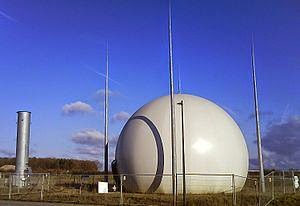
News that the peak market prices are getting out of hand in Poland raises the issue of using more means to balance energy production. The 24 hour cycle seems to be getting worse. Energy storage over a short span of hours seems to be an attractive idea. While there are a number of energy storage solutions using batteries to store electricity, or devices to store kinetic energy to produce electricity later, one of the renewable energy sources itself has the potential to provide output matched to the 24-hour demand cycle - biogas, All biogas plants have biogas storage in some form. The most common is shown below: One biogas vendor explained one of the advantages of gas storage:   " Since the gas-store can hold several hours of gas, the CHP unit can be turned down during off-peak generating times without loss of biogas. The stored biogas can then be burned during high-peak electricity demand hours to maximize revenue efficiency. In addition, the gas store provides a steady s...