Posts

What Will Happen to Polish Renewable Energy on the Current Course?

Image
Perhaps the best way to view the consequences of  the Polish Government and European Commission actions is to refer to the doctrine of unintended consequences. " T h e law of unintended consequences, often cited but rarely defined, is that actions of people—and especially of government—always have effects that are unanticipated or unintended. Economists and other social scientists have heeded its power for centuries; for just as long, politicians and popular opinion have largely ignored it." Norton, Library of Economics and Liberty.   I believe that the Polish Government has been deeply divided on the promotion of renewable energy development.  Many of the "hands on" bureaucrats have tried to find a way through the problems (including the former head of UOKiK). The Prime Minister's office took over the legislative process in the summer of 2013 as the earlier draft that was prepared to meet UOKiK and the Commission's concerns  was being finalized with cor...

The Office of Competition Agreed that Notification of Brussels was Required (before the head of the office was fired)

Image
The Polish Government has made some very misleading statements to the Parliament in the last few months. Pretty much everything that they have stated publicly about state aid for RES and CHP has been 180 degrees from the truth. Let me first summarize the issue in lay terms.  The European Union  is based on the idea of a single economic market. Aid to enterprises by national governments is restricted by the treaty, since it can adversely affect competition. So all state aid has to be approved in advance by the European Commission to assure that it is fair to competition and  does not distort the market. Poland never notified Brussels on its renewable energy program. So it is all unlawful until approved. Similar programs for the UK and Romania were ruled to be state aid and the Commission required that different technologies had to receive levelized support, so that competition was not distorted. Poland did two prohibited things: first, old hydro plants that were built ...

Cover Up? Missing UOKiK document

Image
On May 30, 2014, the Ministry of Economy was reported to have decided not to notify the European Commission on the new law on renewable energy.  The Ministry released a group of documents from the Competition Bureau which allegedly supported their conclusion that notification of the bill as state aid was not required. See  Original article. I jumped on the documents and downloaded them (a bulky pdf image file of 30 pages). Part of the bundle was a June 5, 2012 letter from the former head of UOKiK to the Ministry of Economy. That letter actually concluded that green certificates were state aid, that they had to be notified, and that they had to be levelized to reflect the actual costs of production across technologies. Following that letter, the Ministry proposed the October 2012 version of the RES laws which implemented those recommendations, including phasing out aid for co-firing and old hydro plants. We all know that the next thing that happened was the Finance Minister int...

The Consequences of Proceeding to Auctions Without Notification

Image
The Polish Government in its famous double down is still talking about going ahead with a new support system without notification to the European Commission as required by the European Treaty for new state aid measures. This decision, if it sticks, will mark one of the most suicidal moves since Thelma and Louise  drove their car over the cliff. The rationale for this decision is that the system is either not "state aid" (despite multiple Commission decisions that say the opposite) or that it is exempt under new rules  (which have only been proposed and exclude the type of auction proposed here). The legal explanation for this bold move relies upon a series of UKOK (competition agency) letters which within their context do not even support the decision. What happens if the Polish Government is wrong, which there is every indication is the case? For background, the current system of Green Certificates is certainly state aid (as the Commission has ruled in the case of ...

Energy Storage Economics 101: Finding the Business Case

Image
This is the balancing market in Poland this week, July 15th. The peak two hour period in the middle of the day saw electricity prices at nearly 1000 PLN/MWhr. That is over twice the price of renewable energy in Poland even with subsidies included.  It does not take a genius to see the potential of storing the energy on each end of this spectrum and selling it in the middle. The system must have the production capacity to meet the peak at any time, even though it is used only two or three hours a day. Shifting peak hours to off-peak electricity that is stored, if ubiquitous enough, would lower the need for additional capacity and save everyone money as well. The major energy storage issue is quantifying the economic benefits and finding the optimum methodology of distributing the cost of storage to the beneficiaries of storage. This is not an easy thing and is exactly why we need an association to work to pull all the pieces together and build a consensus of the results.

THE NEW POLISH RES LAW NEEDS TO PROMOTE ENERGY STORAGE

Image
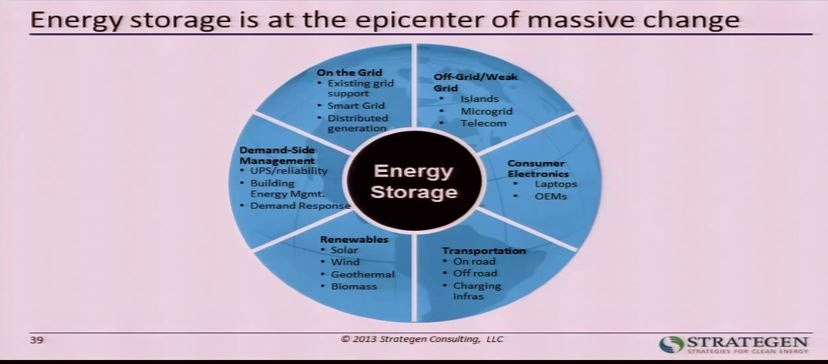
     Poland has a unique opportunity to avoid some of the problems now confronting Germany, as intermittent renewable energy sources take over the first slot in meeting demand for electricity. It has been widely reported that as intermittent energy sources play a larger role in the grid supply, more pressure is placed on “ramping up” power to meet demand peaks. Coal plants are notoriously poor at ramping up or simply backing up renewable energy sources, since they require a high utilization rate to remain economically viable. In this regard, Poland is more vulnerable to mismatched supply and demand than many other countries. This has been one of the main concerns of the Polish Government is debating the new law on renewable energy.       Yet the Government’s various versions of the law have never dealt in any fashion with energy storage. The term does not ever appear in the different versions of the law. Energy storage is viewed as vital to bridg...

Basic Orientation on Energy Storage

Image
This youtube video brings it all together. https://www.youtube.com/watch?v=h2iyQcXQUSw I expect to be in this market in Poland in 90-120 days. I hope to form the Polish Energy Storage Association at the same time.  Interested parties should contact me!  randymott (at) envirosolutions.co. Note: I am still in the biogas business and environmental consulting business.

EU notification or not? Political Repercussions Inevitable

Image
The Ministry for Infrastructure is raising issues about the announced intention of the Polish Government not to notify Brussels on the new law. [They never notified on the existing law and are in an enforcement case with the Commission on the subject]. The Ministry's point is not one of mine and may even be a "stalking horse" for the real arguments which are harder to admit (i.e. the auction is not technologically neutral, the procedure is not transparent, Green Certificates are still used without necessary Commission approval, and the whole exemption relied upon is not even finalized yet). Failure to notify will lead to a Commission complaint and the review will be done by Brussels whether the Polish Government seeks it or not. The ruling coalition seems to be convinced that it is somehow served by delaying the inevitable smack down. My own educated guess is that the smack down will occur in time to be an issue in the elections next year, so their timing is totally ...

The Small RES Auction: Where will the Competition Come from?

Image
The draft RES law in Poland provides for an auction for electricity support for green energy beginning sometime in 2017. There is a faint hope that this will be 2016 if the Government is successful in bypassing the EU notification process (an unlikely contingency). When the auction day does arrive, if at all, the small auction for under one MW projects will have a result completely at odds with the announced objectives of the Government. If and when the day comes, the Government will reserve 25% of the auction for small producers, i.e. under 1 MW. While I have objected to the 1 MW and to the requirement that an auction be used, it is interesting to speculate on the effects of this proposal if it is realized. Pre-qualification of bids will be required, which will include the need to have planning permission, environmental approval, gird connection conditions and a building permit for your project. A deposit with the bid and penalties for failure to build the project if your bid is...

Time to Invest in Renewables in Poland

Image
As the situation is developing in the Polish RES market, everyone with a viable project is rushing to build it. Construction in the next 18-24 months, means that a project can opt for the auction or Green Certificates (which ever appears more advantageous. While uncertainties are keeping the biggest and most conservative investors and banks on the sidelines, the most entrepreneurial folks are jumping in. Smart investors know that the certificate values will go up dramatically due to the European Commission future actions. The small developers will have big problems with an auction system, but well-funded developers will win support and the small auction (now under 1 MW) will create a situation of limited competition. I have argued without a break that the auction mechanism is bad for small projects. Over 90% of the Polish biogas developers are small investors, often only doing one or two projects. Biogas has difficulties in the auction experiences from other countries. I will conti...

Time for Conference on State Aid and Renewable Energy?

Image
I have organized a panel of legal experts to discuss the issue surrounding state aid to renewable energy and the new Guidelines. Unfortunately, we have been unable to obtain any sponsors. As readers know from my posts and articles, this issue is huge and will decide the future of renewable energy in Poland. I think we urgently need a dialogue on the issues and solutions. Now that there is a more public discussion of the issues, including UKOK's correspondence, maybe the situation has changed? It is impossible to discuss the future of the RES bill without taking this issue into account. Some of us think that it has already been one of the major factors in the delays and decisions made by the Polish Government. Any companies or organizations that would like to be sponsors for a conference with the leading legal experts in Europe on the subject should contact me. randymott  @  envirosolutions.co.

DOUBLING DOWN ON A JUNK POKER HAND: THE POLISH GOVERNMENT APPARENTLY INTENDS TO IGNORE ITS TREATY OBLIGATIONS ON STATE AID

Image
     To anyone who has even a casual acquaintance with gambling, “doubling down” is a well-known and often dangerous strategy. The Oxford Dictionary defines it as to “ strengthen one’s commitment to a particular strategy or course of action, typically one that is potentially risky.”  Doubling down or increasing your bet when you know that your cards are losers probably goes by a more generic name, say “stupidity.” Operating since 2005 under a renewable energy support system that is unquestionably state aid, while ignoring the obligation to notify and obtain approval in Brussels under its treaty obligations, the Polish Government now seems poised to plunge ahead with more aid and no more notification. The Green Certificate program is totally intertwined with the new program since it can still be opted into by existing RES producers and since the reference price in the auction for existing sources is pegged to its value. Nor does the form of auction pr...