Posts

Polish Presidential Election: Implications for Renewable Energy

Image
In the opinion of many, Civic Platform (PO) has grown a bit arrogant and very non-transparent in its model of governing. Pundits will have a dozen explanations for the election of Andrzej Duda yesterday, but wide-spread support for his party, Law and Justice (PiS), is not one of them. Voters signaled their concern about PO and wanted something else....just about anything else. If this trend continues into the Parliamentary elections, as I think it will to a lesser degree, expect PiS gains but no majority. A weaker coalition government with PO, PSL and possibly SLD is the most likely outcome. It is important to remember that all of the political parties are publicly pro-coal and none of them have a real program to address the growing economic and technological challenge in Polish energy to shift to the "next thing."  PiS is more likely to make foreign energy investors nervous, however, with their more xenophobic rhetoric. PiS is widely described as anti-wind energy and w...

Fossil Fuel Subsidies: The Myth of a Free Market Shattered

Image
My Republican colleagues typically comment on renewable energy, that if it is viable it would survive without subsidies. They point to fossil fuels and claim that green energy should receive the same treatment, i.e. only market-based revenue and investment. But this myth is wholly at odds with the reality around the world. Fossil fuels have been one of the most heavily subsidized human endeavors in the history of the world. The International Monetary Fund report , just released, notes that globally fossil fuels receive approximately $600 million a HOUR in government support. See PL article.  The basis of this huge cost figure is the externalities of fossil fuel burning (mainly coal). There are several new reports of the huge external cost of burning coal in Poland (which leads Europe in air pollution for fossil fuels). But even the narrow definition of subsidies for internal costs results in a big figure for support. Over 10 billion Euro a year in Europe (where the policy is ...

Simulated Auction by Polish Wind Association: Predictable Problems

Image
The Polish Wind Energy Association just conducted a mock auction for renewable energy support using the system included in the new Polish law. The results foretell the problems we can expect in the actual auction and are not surprising. The main take-away by the association was the under-bidding in the large auction (over 1 MW projects) and less than 4000 MWhr/MW. The prices were unrealistically low. This phenomenon is very common in RES auctions. Bids are speculative and below the real costs of doing the projects in the hope of snagging the support. This is a very common - maybe unavoidable  - problem with reverse auctions: “ While auctions aim for a specific amount of electricity to be produced or capacity to be installed, empirical experience has shown that a shortfall of the auctioned amount is a rather common phenomenon. This is mainly due to ‘underbidding,’ which results in economically non-feasible projects .” EcoFys,  Design features of support schemes for renew...

EU State Aid Guidelines: Huge Problems Ahead

Image
I have done a full analysis with detailed references on the problems with the new EU State Aid Guidelines for Renewable Energy. The paper will be published in the May edition of the European Energy Journal .  It is also being presented at the PowerGen 201 5 conference in Amsterdam on June 10, 2015. My take is that the guidelines are an effort to try to mitigate threats to power energy utilities. They push support into auctions, a mechanism proven to be bias in favor of large established utility bidders. They will hurt smaller investors and equity investment funds. They bungle the support for energy storage (electricity stored from renewable sources is not considered green after it is stored!). They hurt distributed energy by requiring sources over 500 kW to feed to the grid. The create massive uncertainty over 2020 targets by changing all the rules in the last lap of the race. They tie up renewable energy efforts by restricting what is financially feasible and enviro...

Renewable Energy Update from Poland

Image
There are still some issues to be decided on the shape of the new law on renewable energy. The biggest one for us in the biogas sector is the reference prices, since it is widely expected that the under 1 MW small auction for projects with more than 4000 MWhr/MW a year will be under-subscribed. The Deputy Minister of Economy gave a 500-600 PLN/MWhr cost estimate in the Parliamentary debates, but this is lower than the Institute for Renewable Energy estimates of the cost of production in their 2013 report commissioned by the same Ministry. He also predicted that all small projects that pre-qualify and bid within the maximum reference price should receive support. This would mean a base price of 190 PLN/MWhr plus the factor times 300 PLN. Since the final law only provides for under 1 MW in practice, the figures would be: 200-500 kW = well over 1000 PLN; 500-1000 kW = 970 PLN. These figures are consistent with numerous studies of the costs of production and are much higher tha...

Energy Storage and the New EC State Aid Rules: Oops!

Image
The new state aid rules require that electricity over 500 kW be sold to the grid. See 3.3.2.1. par. 125 . This, of course, is designed to frustrate distributed energy, which is emerging as the development that will change the whole utility industry. But in the fine print, the new Guidelines also seriously impede energy storage. Electricity coming from energy storage that was renewable going into storage is no longer renewable coming out of storage. Definitions 1.3(19)(11) . No operating support is possible if the guidelines are followed. This means that the RES producer must own his storage device to get any credit for the energy he produces and stores. Operators owning storage devices (charged by third-parties) will not have any green support apparently since what they sell coming out of storage does not qualify for support under the guidelines. But there is another catch, the guidelines also require that the electricity be sold to the grid to receive operating support, except ...

Comparative Cost of Producing Energy

Image
Here are some graphics on what it costs to produce electricity by technology. This does not count the cost of distribution, which heavily favors renewable energy that is locally produced and can be used locally without major distribution costs. EdF is seeking a price for UK nuclear energy at 90 GB/MWhr (500 PLN) which is more than the average RES price projected under the new Polish law. Wind and PV will both be much, much lower by the time the UK opens a nuclear plant (if ever). The UK capex cost is 14 billion GB or 78 billion PLN. Both the energy price and the capex keep going up (these are from EdF in October 2014). There is no real dispute that RES will be the cheapest energy available (especially with lower distribution costs) in the relatively near term future.

UK Illustrates How Fast RES Can Deploy(without auctions)

Image
The UK just went from 4 percent renewable energy in 2013 to 19% in 2014 . This is the pre-auction surge under their old system. But it illustrrates that RES projects can be rapidly developed in a system that is stable (aid to co-firing in the UK is restricted). Wind and PV have development schedules that are quite short compared to other electricity production. Auctions will delay projects, since they cannot be put online as they are prepared. The dilemma of auctions is always that strict penalties deter bids and lower pre-qualificatgion requirements and lower penalties encourage bidders to under-bid and under-build. See EcoFys (2014). An additional problem that I have suggested (I never saw this mentioned by anyone else) is that projects to be eligible  to bid must have all of the legal means of producing energy tied up in legal agreements and a substantial percent of these will lose the auction or not even be bid in the end. So, using the European Commission suggestion that t...

Victories for Biogas in Poland?

Image
Checking out the law in detail to ask questions to URE..... there appear to be some good provisions for biogas in Poland if they are implemented intelligently. The scope of biogas is changed to include all of the biomass allowed by the EU definition in the RES Directive. A change we (the Polish Biogas Association) urged them to make. There is a question of how the reference price will be set for this category (other biogas), but they will have to be guided by cost of production under state aid rules. The cost is the same or higher than agricultural plants. We would like additives like glycerin and enzymes added to the possible feed-stocks allowed by the law with a 2 % volumetric limit. This reflects the same rule the European Commission worked on for the End-of-Waste criteria for biowaste. The 4000 hour "basket" [a set-aside for projects producing over 4000 MWhr per 1  MW of capacity] should allow biogas plants to win support up to the reference price level. So the bi...

United States Renewable Energy Continues to Surge: Using the System that Poland Wants to Abandon

Image
About 30 states in the United States use a "residential portfolio system for renewable energy, a quota system set by the public utility commission in the state which requires a fixed percent renewable electricity. This is sustained by certificates, as in Poland. Unlike Poland, co-firing biomass with coal is not traditionally popular.  The United States has reached 14% renewable energy remarkably in a huge market when conventional electricity is much cheaper than in Europe. The pace of RES growth continues in 2015. The U.S. Energy Information Agency estimates that renewables will contribute to a majority of the electricity production growth in 2015. Even low natural gas prices have not affected RES growth. The major loser has been coal-fired plants. The lesson of RES growth without a significant impact on consumer prices (Livermore National Laboratory) has been generally lost to Europe, Competition among electricity producers is enhanced by RES development which helps to off...

Ridiculous Rhetoric About State Aid ... from the Experts on Using Illegal Aid

Image
The ongoing discussion about trying to block the prosumer support in the final law due to "state aid" issues is about an hypocritical as it gets. PO spokesmen raised this earlier and it appears that the President of Poland may not take the bait. A good decision, since the entire Polish support system has been operating illegally for nine years and the Government has known this for at least three years now. Similarly, we have been seeing a big bluff on whether the new law must be notified to Brussels. Everyone privately knows that it must be notified, reviewed and approved. For several reasons, it does not meet the block grant exemption from notification. Most obviously, it continues support in the form of Green Certificates which the European Commission has advised informally to UOKiK are state aid. Aid up to 2017 must be levelized by technology and certainly all of the technologies including in the Polish National Action Plan for 2020 will have to be included. Other ...

Polish Government Assures Folks that Electricity Prices Will Not be Affected by Reality

Image
In the discussion after the law to transpose the new deal on European emissions controls and CO2 allowances, the Minister of Environment reassures the public that electricity prices wil not go up after 2020.   His basis for optimism is the free allowances given to Poland as a part of the deal reached with Brussels a few months ago. I commented at the time that the allowances and funding provided would be way short of what is necessary to provide a soft landing for Poland (as long as the country was clinging to coal as its central energy source). Now it seems clear that the assumptions on the limited impact of the deal on Poland were likely a fantasy. Much of the aid provided is supposed to go to de-carbonization of the Polish economy, not to preserving reliance on carbon. However, the aid is manipulated by Warsaw will likely not provide more than a fraction of the funds necessary to modernize the Polish energy sector. The impact of higher prices per ton of CO2 in the emis...

Painful to Watch: Polish Government's Promises on Shale Gas Hit Reality

Image
"As reported gazlupkowy.pl, Lane Energy Poland, whose shareholder is an American company ConocnoPhilips decided to liquidate a total of 5 wells for shale gas including the Łebień and Strzeszewie."  UPDATE NOTE: Another shale gas developer announces the end: " The Board of Petrolinvest decided to suspend projects in oil and gas exploration in shale deposits, writes "Rzeczpospolita" and notes that a few years ago, the company saw in these projects huge growth potential.  "

What the UK RES auctions Prove and Do Not Prove

Image
The UK Government has started a propaganda effort boasting of the results of its renewable energy auctions. There are some lessons proven here and some issues still not obvious to the casual observer. 1. The UK cut off the auction mechanism at 5 MW. Auctions do not work well for small projects and this has been proven time after time. Poland is attempting auctions for less than 1 MW and the results will surely not be stellar. 2. The UK conducted so-called "banding" where there are separate auctions for each technology. This is a procedure that follows the advice of most experts, including ECOFYS in their detailed report to the European Commission last year. The DG Competition in Brussels authorizes this, but still irrationally prefers technology neutral auctions (which they try to exempt for state aid review in the GBER regulation). Poland will try to conduct generally technology neutral auctions, broken down only by under and over 1 MW with a basket for projects producin...

Censorship?

Image
Apparently I am being censored now by GramwZielone. Some of my comments are being considered spam. I think that this is because I am one of the only people in Poland who is accurately describing what is going on and why the RES rules are structured to favor the state-owned utilities. Many Poles, especially in the environmental movement and in the renewable energy sector, have approached me to thank me for the commentary. They almost always say that they are glad someone is saying this, because they feel that they cannot do so. The legacy of communism or a practical view of freedom of speech in Poland? I strongly feel that the green energy sector is under an additional measure of self censorship - every trade association in renewable energy includes the big utilities that also have green energy projects. They effectively mute the responses of the sector where the interest of the traditional utilities clashes with the emerging technologies . This is true in Brussels as well as Wa...

Speculation on the Political Consequences of Polish Green Energy Controversies

Image
Historically, no one in Poland much cared for the environment. It was simply very low on the list of concerns and basically off the radar. Changes in this attitude are now, however, really profound. February 2015 polling by CBOS showed 77% public support for expanding renewable energy in Poland (higher than any other energy source). These changes manifested themselves in the debate on the renewable energy bill, where every political party jumped on the green energy issues (the prosumer amendment), except Civic Platform (PO), known also as the political office of PGE. Civic Platform has gotten itself painted into a corner that essentially assumes whatever it good for PGE is good for Poland. While taking care to avoid seriously disrupting a major part of the nation's electricity production and distribution is a reasonable plan, measuring every change in the energy landscape solely be its effects on PGE profits and dividends is, of course, over the top. PGE and other state-owned uti...

Energy Storage: The Future is Inevitable

Here is an excellent summary of the state of energy storage in the world. Energy Storage Market Outlook 2015 Slow and steady growth predicted for this renewable energy enabling technology. Paul Hockenos, International Correspondent  February 11, 2015   In Poland, at least the new law will allow energy coming out of storage to retain its  renewable   characteristic  and still receive support. Article 2(13) Law of January 16, 2015. Once the PV support system is sorted out in the new Polish rules, I expect that energy storage for PV will be cost-effective. The market perceptions are, however, lagging behind where I think technology already is.

How We Got Here is Not as Important as Where We Are: RES in Poland

Image
We finally, it appears at least, have a new law on renewable energy in Poland. The process has been ugly, ignorant and often deceitful. Like all efforts at government control of economic activity, it will be full of unintended consequences. The day of reckoning in Brussels has been postponed until now, but not canceled.  The two biggest issues facing the country in RES are first the transition from one support system to another (understanding that many facilities will continue to have Green Certificates, that the quota system remains in place,  and that auctions in 2016 or 2017 may do relatively little to affect the mix of RES in 2020). This issue also has the enormous problem of revolving around unnotified unlawful state aid in the form of the certificates. This year, Poland will likely get the final notice from the Commission that this has to stop, meaning that another piece of legislation trying to retroactively adjust the current system to EU law will be required. This...

Shale Gas in Poland: The Fading Dream

The news is that Chevron in pulling out, following the other major international firms. Now a realistic analysis in the European trade press: Shale gas a distant prospect? By Nicholas Newman In 2013 the US Energy Administration estimated that Europe contained 470 trillion cubic feet (Tcf) of potentially recoverable shale gas, equivalent to 80% of US reserves. Given the size of Europe’s potential shale gas reserves and the EU’s declared intent to constrain climate change, while still protecting energy security, it is surprising that exploration for shale gas has been so little and so slow. Poland, the UK, France, Ukraine, Romania and Germany are all countries, which are estimated to have significant shale gas resources, but, with only 55 rigs in operation, knowledge of Europe’s geological share heritage is sparse, though early indications are that the shale plays are deeper at around 5000-6000 metres compared to 3000-4000 metres in the US. "There is no escape from the ...

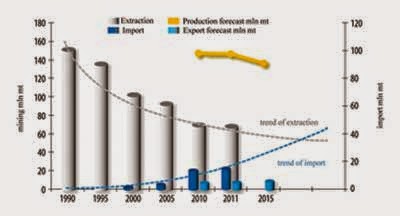
Polish Deal on Coal Mines: Reality Challenged

Image
 Okay, to be politically correct, you might not be able to say it is a completely phony political move designed only to placate voters in the mining region for the next two years or so. So let's say it is simply reality challenged. A good summary in Polish of the problems with the deal is here . There is an excellent chance that much or all of the government help postulated will be illegal state aid, i.e. the EU only allows state aid to liquidate coal mines, not to sustain them. See European COUNCIL DECISION of 10 December 2010 on State aid to facilitate the closure of uncompetitive coal mines ( 2010/787/EU ). Pretty strong stuff: "The Union’s policy of encouraging renewable energy  sources and a sustainable and safe low-carbon economy  does not justify the indefinite support for uncompetitive coal mines." Id.   Support is only authorized for "measures to alleviate the social and regional consequences of the closure of those  mines, that is to say ...