Posts

Polish Legislature Passes New RES law: Great News for Biogas

Image
I have argued for several years that auctions are singularly ill-suited for biogas projects. The upfront cost of developing a biogas project is proportionally more than other RES technologies, so the risk of not obtaining support at the completion of project development is very high. See discussion on Polish Biogas Association on support mechanisms.   In English here . More discussion here. Now the new government has recognized this and provides for biogas plants up to 1 MW to receive an guaranteed level of support. The reference prices have now also been adjusted to allow for profitable biogas projects that are well-structured and utilize heat. See Polish Biogas Association comments on reference prices 2015.   The direct sale of electricity is also allowed for these small projects which enormously incentivizes cooperation with food and meat plants that can provide their wastes in a nearby biogas plant. The full legislative text will be finalized shortly. The critical iss...

New Rules on Polish Auctions for Biogas

Image
The shape of the RES amendments now proceeding in the legislature in Poland reflects what I predicted. This is the first set of rules to have been scrutinized by the European Commission DG Competition on state aid and the changes are generally better for RES developers. There is strong support for biogas in both pricing and procedures. The reference price in the auction is quite acceptable, especially for projects that use waste feed stock and have heat sale contracts. The apparent shift in calculating state aid deductions from the energy price awarded will put plants without government grants on equal footing in the bidding. These amendments were required by the European Commission to allow the auctions to proceed under compliance with EU state aid rules. This is the first major adjustment of the Polish system to comply.  It also adds some wind capacity to the auctions and signals a change in the dogmatic position on wind, which the European Commission no doubt found objectio...

Finally? A Signal that Maybe Reality Matters, Even in Poland

Image
The Polish Minister of Energy has finally started talking about a compromise between renewable energy and coal.     The driver is apparently the new public concerns over air pollution, which has got to the point where some days you cannot exercise outside in Poland. There is finally some talk of a transition from predominantly coal supplied electricity. But the government still does not discuss in real terms the economic and technological changes occurring in the energy market. The cost of coal - not even considering the external costs - is getting to be more expensive than RES technologies as the latter are rapidly going down. The additional cost trend in energy storage is also not fully appreciated in Poland.  Critical thinking requires that energy projects be considered over their projected useful life, not just at today's prices. Private investors think in this manner, but many governments do not. The Polish distrust of business runs deep in the cu...

Dramatic Changes in Costs Shifting the Debate on Renewable Energy

Image
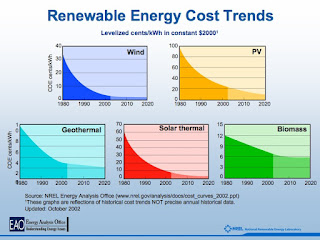
    The standard refrain from opponents of renewable energy is that it is expensive and too variable for a stable grid. These arguments have always been exaggerated, so several European countries have high RES penetration without serious problems. But now the arguments against RES have an obviously expiring shelve life. They have simply been out-paced by technological and economic developments.     The latest news comes from a new January 2018 report by the International Renewable Energy Agency (IRENA).  Their conclusions : Renewable power generation costs continue to fall and are already very competitive to meet needs for new capacity. Competitive procurement – including auctions – accounts for a small fraction of global renewable energy deployment. Yet these mechanisms are very rapidly driving down costs in new markets.. Global competition is helping to spread the best project development practices, reducing technology and project risk and making r...

Renewable Energy in Poland Slowed Down by Auction Mechanism

Image
When Poland announced the cut-off of green certificates for new installations and the plans to move to auctions, I predicted that there would be a major gap in development of renewable energy sources. The problem is that the auction has to provide a lengthy window for facilities to actually start producing electricity. Cutting off new certificates along with their market demise meant that there would not be actual new production coming on line in the transition period. This situation has occurred now and new RES is only a trickle into the grid. This will not be alleviated by the existing system of certificates, since the huge over-supply can be used to meet the RES quotas. So Polish electricity producers can meet the RES requirement by stockpiled certificates without any new actual green electricity production. This is fine for the immediate legal environment, i.e. they can be in compliance with the law.  But Poland has a national target for RES for 2020 that cannot ...

New Financial Support for Biogas in Poland [expanded version]

Image
Randy M. Mott JD, vice president Polish Biogas Association, President of Central and Eastern Europe Renewable Energy Solutions (CEERES) [1]      The European Commission finally approved the new amendment and total Polish RES support package.   S A.43697 Polish support scheme for RES and relief for energy-intensive users (December 13, 2017).      The decision frees the way for new auctions in 2018 and likely running into 2021 and maybe beyond.      The Energy Regulatory Agency has announced a new agricultural biogas [2] auction reference price of 570 PLN/MWh which is the highest yet proposed in Poland.      From the " High Voltage" newsletter  in Poland:  " The most, nearly 18 billion zlotys, or almost half of the entire budget approved by Brussels, may be absorbed by - planned by the government - increase in production in biogas installations from the current 1 TWh per...

Biogas in Poland Gets Huge Boost

Image
The European Commission finally approved the new amendment and total Polish RES support package.   S A.43697 Polish support scheme for RES and relief for energy-intensive users (December 13, 2017).    The decision frees the way for new auctions in 2018 and likely running into 2021 and maybe beyond. The Energy Regulatory Agency has announced a new agricultural  biogas auction reference price of 570 PLN/MWHr which is the highest yet proposed in Poland. From the " High Voltage" newsletter in Poland:  " The most, nearly 18 billion zlotys, or almost half of the entire budget approved by Brussels, may be absorbed by - planned by the government - increase in production in biogas installations from the current 1 TWh per year to 4 TWh in 2020.  At the same time, achieving this goal in such a short time seems to be impossible, but most likely by 2020 the government will at least contract a comparable volume in installations that will be built at the beginning ...

Energy Storage Costs Will be Bankable by 2020

Image
From a recent study : " Relying on arbitrage or peak-shaving alone does not make for a convincing business case. Pressure from government regulations may also have an effect on the numbers. Official targets to increase energy storage capacity, such as those  announced just this month in New York , put pressure on even more utilities to develop their own energy storage solutions. We still have to wait for technology costs to fall enough to make energy storage projects bankable on their own. Current estimates think battery energy storage technology  could be competitive as early as 2020 . Until we reach that point, developers must continue finding innovative ways to combine energy storage with other applications or seek out value stacking opportunities to better make their business case." Much if the issue revolves around where the income for energy storage comes from. The case of doing energy storage is strong right now, but most regulatory schemes do not provide su...

Polish Auctions Will Only Occur Under Better Conditions

Image
The combination of the European Commission and the Energy Regulatory Agency in Poland is delaying new RES auctions. The need to have procedures approved by the EU has been a constant source of friction in Warsaw. This is unlikely to abate until an agreement is reached. Until then, the URE dispute with the Ministry of Energy looks like it will create a wall of confusion over future auctions. The Polish Government has conceded that RES support is state aid and as such it must be approved by the DG Competition in Brussels. That is a given, but has been handled carelessly from the beginning with PO and now the new government. When auctions proceed with EU approval, I expect the conditions to be better. In the interim, RES is frozen in Poland.

Hurricanes and Climate Change

Image
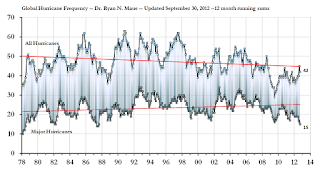
I am committed to renewable energy due to its positive environmental effects, but mostly because of its long-term cost-effectiveness and empowerment of people by decentralizing energy production. However, that does not mean that I must buy into the climate change (aka "global warming") theory.  In this period of horrible hurricanes, it is important to keep an objective mind set. Critical data does not support the premise that CO2 levels are a major driver that changes global climate. My previous posts have cited the geophysical data that shows no correlation between CO2 levels and temperature change in the earth's history. Now there is even more evidence that CO2 is a minor driver of temperature that is more than offset by negative feedbacks that overcome its warming effect. Hurricane Frequency The data simply do not support any notion that hurricanes are growing in frequency with CO2 levels. Nor is there any correlation between CO2 levels and the occurrence of  ...

Renewable Energy Declining in Poland

Image
Inevitably when the government replaced a system that allowed continuous additions of renewable energy with a new system that only provided for periodic approval of projects on a scheduled delayed by the bureaucratic process, the level of new renewable energy being produced has declined. New auctions will give the winners until after 2020 to build the projects and there is no schedule for the next auction approaching mid-2017. More changes are in the offing and - while they may likely improve the situation - they will also delay any new start-ups. "High Voltage" reports   that the system is slowing down down every month. The likelihood of Poland hitting the 2020 mandatory goal for production of renewable energy is now remote. There are glimmers of hope in the new system for biogas and larger PV projects, but investors have been shell-shocked by the government assault on wind energy and are generally sitting this round out. Many mistakes have been made by the last two ...

Energy Storage is Described as a Dream in Poland, but is Rapidly Expanding in the United States

Image
This is really a bit counter-intuitive, since electricity is much cheaper in the United States. But storing excess electricity for subsequent use to meet peak demand periods or down-time in the grid is moving ahead in the United States where there is lower marginal economy for storage than in Poland. "... 21 U.S. states now have 20 megawatts of energy storage projects proposed, in construction or deployed. In fact, 10 U.S. states have pipelines greater than 100 megawatts."   GTM Research, March 2017. You have to also note that 20 MW of storage is comparable to a 40 MW peaker plant, since the 20 MW capacity occurs ion the tip and bottom of demand. Ironically, energy storage seems likely to increase the profitable of remaining fossil fuel plants which depend on high levels of utilization to be profitable at all. Keeping fossil fuel, especially coal capacity as in Poland, on hand just to meet the very top of peak demand is very inefficient. In yet another area, we a...

Profitable Niches in Polish Renewable Energy

Image
While the green certificate prices are wiping out anyone who depends on this support mechanism, and the next round of auctions for support under the new system are delayed by European Commission review, there still is emerging clear evidence of successful niche markets in Polish RES. Biogas will receive 550 PLN/MWhr and will hopefully receive co-generation support under new legislation still to be passed. At this price, biogas from organic wastes from food, poultry and meat processing is profitable. Household food waste may promise to add to the substrates as the EU moves to require separate collections. However, biogas plants (mesophilic) using farm substrates (manure, silage and grain) are not profitable at the same level of support without capex grants. Virtually all of the farm-based plants in Poland started with grant support. Existing biogas plants on farms have moved to "blue certificates" based on a unique obligation of electricity providers to have a certain numb...

End of an Era: Coal Investment Drying Up

Image
Now a new report by environmental NGOs is out that shows a huge change in the global energy investment profile. Some key conclusions: "After a decade of unprecedented expansion, the amount of coal power capacity under development worldwide saw a dramatic drop in 2016, mainly due to shifting policies and economic conditions in China and India, according to a survey by CoalSwarm’s Global Coal Plant Tracker. The drop occurred in all stages of coal plant development, including preconstruction planning, construction starts, and in-progress construction. Key developments include: ■ A 48% drop in pre-construction activity, a 62% drop in construction starts, and a 19% drop in ongoing construction. As of January 2017 the amount of coal power capacity in pre-construction planning was 570 gigawatts (GW), compared to 1,090 GW in January 2016. (A typical coal-fired generating unit is 500 MW, or 0.5 GW, in size, with most power stations having two or more such units.) ■ In China and ...

Energy Storage and Demand Management Offer a Solution to the Problem Polish Officials Keep Raising: They Just Don't Want to Face it

Image
The constant complaint of all Polish politicians has been that renewable energy is intermittent. Besides the fundamentally fact-challenged premise that this is a problem with Poland's relatively low mix of renewables,*  the best solutions to this problem with a higher portion of renewable energy in the mix (as well as unreliable coal-fired plants like in Poland) is demand management (differential rates that push more users into non-peak periods) and energy storage. Near the Polish border, a new German project will create a 16 MW energy storage facility to manage the even flow of electricity to the local grid. " W Chemnitz powstanie duży magazyn energii, " Gramzielone.pl, March 8, 2017. Nothing like this is even in planning stages in Poland.  For misplaced political reasons, Polish politicians continue to think that coal is both reliable and cost-effective to produce electricity. They are alone in Europe in this viewpoint. It may not be realistic to switch off the coal...

Pushing Electric Cars Will Do Little to Fight Air Pollution in Poland

Image
We have now seen a real PR blitz on "electro-mobility" in Poland . It seems on the surface that the Polish Government finally gets that it has to address air pollution problems. The data on the air in Poland is appalling, maybe they will take it seriously now? Maybe not. The problem is automotive emissions is old cars. One old "smoker" will easy emit more junk into the air than several hundred new cars. Even in countries, like Canada, will much newer average cars on the road, most of the emissions come from less than 25% of the vehicles . In Poland, with much older autos in common use and with no vehicle emissions inspection program, the older cars will have a much, much greater impact on total emissions. So enter the electric car...zero emissions. Solution? Not really. First, the people buying new electric cars will not be the people driving "smokers."  So it is easy to see how replacing even 20% of the current cars with electric cars...

Polish Auction Not Exempt from Typical Problems

Image
The first Polish auction had, of course, major technical problems. But it is worth looking at whether it avoided the classic failures of RES auctions elsewhere (as discussed in numerous posts on this blog). See also Mott, " The European Commission's Mismanagementof State Aid Rules for Renewable Energy " (2015). First, the problem for small projects is that much of the costs of initial development is actually about the same as for projects fifty or a hundred times as large. The front-end costs must be absorbed by the developer before the auction and before he is assured of getting any support. This typically has killed small projects in auctions. Often there are no bids at all. Poland experienced this in some degree as the bids made for small projects were lower than the allocated volume of RES support offered. Second, projects are under-bid. The developer puts in a price that is very low and then hopes that the financing will be there and that the costs by the time of...

First RES Auction in Poland: Problems and Opportunities

Image
The first RES auction in Poland had problems and bidders could not complete their offers online. But the Ministry has decided to go ahead and award support from those bids that were received. Some issues arise since the bidding was arbitrarily cut-off due to technical problems and because the number of bids seems to be less than the support that was awarded. See European Commission, State Aid Guidelines for environmental Protection, 2014,Sec. 1.3(19)(43). Bidders had to conside r state aid density in their bids and count any grants received to avoid a total amount of support that exceeded the EC guidelines. This is a complex calculation, but the results of the auction seem to reflect that it did not constrain bids by very much. Seven biogas plants bid and won with prices from 502-504 PLN/MWhr. The reference price is 550 PLN. PV plants bid and won many more awards in the up to 1 MW general category. Prices for those winning bids are not yet clear from the published information. ...

Polish RES Auction Starts Today: Observations to Follow

Image
Today the Polish Government starts its first auction for renewable energy support. The principal focus will be existing installations that now have an option to opt for a contract-for-the-difference to replace green certificate support (now special blue certificates for biogas). Some new facilities will also bid in another category. Most of the facilities participating with have grants for their projects - either already built or already contracted. This means that their bids must be lowered to meet state aid ceilings imposed by the EU. Accordingly, the bids today may not be very predictive of future bids in auctions where far fewer projects will have this condition.  I do expect that the number of projects bid will be lower than the government predicted. The hurdles of going into a project without a guarantee of support are quite significant and everywhere else they have reduced participation levels of small project developers.  The "competitive" nature of t...