Posts

Critically Evaluating "Sustainable" Investments
Image
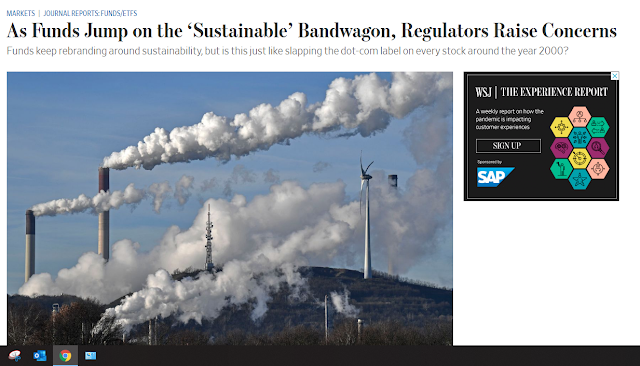
    I caught the WSJ  headline and hoped it would be talking about the dubious nature of many "green investments." Many are not particularly "green" and others are absolutely stupid business models. Funds normally have little expertise is judging either. If they hire expert support, it is often just some "woke" yuppies will no critical skill set or experience.       The financial studies that praise the economic value in "sustainable investment" fail to sort out the noise. Large, well-run companies find it necessary for the PR to claim "sustainable" policies. Most of this stuff is "green wash" which is the short-hand for saying environmental spin. This is harmless enough on its own. Although experts have struggled for years to show that the even adoption of  actual environmental management systems (i.e. ISO) has a positive correlation with actual environmental performance of a company. Any occasional modest correlation c...

Why travel restrictions and social distancing are important: the Long Game in the Wuhan virus Battle

Image
I don't think that there is very wide understanding of what the travel restrictions and social distancing actually do to help the Wuhan virus crisis. The key to the battle is to halt the exponential growth of the infected population. That allows the natural process of the virus to run its course, but significantly provides the opportunity to treat the affected population within the limits of the healthcare infrastructure. As the virus dies off in the affected population, it is then not reproduced in people newly infected due to the isolation. During this period, we will devise better treatment approaches and a vaccine. If the virus grows in the population unchecked, the healthcare system is over-whelmed and ultimate control is more complicated and costly in the form of more people adversely affected or killed. Travel restrictions start having an effect after about 12 days based on the Chinese experience: the incubation period. Another another couple of wee...

Where Phytoremediation Can Be Practical and Effective, Even Profitable

Image
The new company Phytoremedia (www,phytoremedia) is the first truly commercial scale phytoremediation company in Eastern Europe and one of the few such companies in the world. Phytoremedia has gathered a panel of experts from all over the world to advise on projects and offers a full turn-key solution. Its experts come from Poland, the US, India, Taiwan and Belgium and the team is growing. This approach offers cleanup to regulatory levels for many polluted sites, but has been underutilized due to lack of information among regulators and the affected site owners. It also has a disadvantage of taking several years to implement and many remedial situations occur in the middle of a developers' building schedule. Nevertheless there is a major role that can be played by this attractive technology. .  The company is exploring the best alternatives for phytoremediation: idle land that has been rendered pretty much of little commercial value due to contamination. This can be ...

Using Phytoremediation to Optimize the Resale Value of Your Industrial Site

Image
Contaminated land issues in Poland and other countries mainly arise when a new owner decides that they want to build something, usually in a hurry. The quickest way to address their construction schedule is to "dig an dump." The consequences of this are normally that the seller has to take a huge hit in their sale price to accommodate the remediation bill. Intelligent owners of contaminated land can use their period of ownership to start phytoremediation where it is feasible,  get a plan approved, and then not face discounting of their sale based on a hurry-up and expensive cleanup. In Poland and most of the EU, the cleanup standard is locked to current land use only. This means that the risk assessment may give a site a pass on residual contamination if the site has controlled-access and there are no exposure pathways. Later, the sale of the land can likely be to a developer who wants to do more with it as a commercial property. The cleanup issue will have to be revisite...

GREEN WASH

Image
     Green wash is the artificial use of pro-environment messaging to deceptively convey to the public that a product, policy, or service has major environmental benefits.      It is routine in corporate culture now and also is a major feature of public policy. Some examples:      -  This product is made from "recyclable materials" - the user thinks that it is recycled. Almost anything can be technically recycled. But almost all materials are not economical to recycle and, in fact, are never recycled.      -  Ban on plastics straws - the public thinks that this will reduce plastics pollution in the oceans, a serious problem. But virtually all plastics that end up in he oceans come from China and a handful of less developed countries. Plastics in industrialized countries go to landfills, waste-to-energy plants and even recycling. Ending plastic straws is a gimmick to make the consumer feel good or for the company...

Pragmatic Environmentalist: Watching the Public Fall for Environmental "Feel Good" Scams and Spam

Image
A couple of years ago I wrote this post. Everyone seems to be in a general state of denial about this problem with charging these vehicles in Poland. This is classic "green wash" (the superficial appearance of being environmentally- conscious). The latest green wash is plastic straw bans. Most all of the plastic in the ocean comes from emerging economies where there is often not even household waste service (everyone dumps everything). Plastic in the EU and US will end up in  landfill, waste recovery plant or being recycled. Only a small fraction is capable of being recycled, which itself uses more energy than it saves. Plastic bans in the West will do nothing about plastics in the ocean except make people feel good about themselves, i.e. more virtue-signaling. Just like eliminating all US carbon emissions will only reduce temperature by 0.03 degrees under the UN IPCC's own model: a change that will be quickly swept away by events. The full achievement of the Par...
Image
The  EU Commission continues its battle with Poland  over air pollution.  The air in Poland makes up 33 of the 50 worst urban areas in the EU. Emissions from coal plants, old cars, and household burning are the culprits. Changing things will require a lot more than electric cars now being encouraged, since they remain charged by coal fired power plants and actually increase emissions. I don't think that it really any plan in Poland to do anything different. If there is, it is not clearly in public right now and certainly will not be dramatic enough to work any time soon.
Image
PHYTOREMEDIATION: NEW TECHNOLOGY IN POLAND     Remediation of contaminated land by the use of plants that take up the pollutants is a very promising new approach. Phytoremediation relies on plants that can tolerate growing in contaminated soil and also have the ability to take the pollutants out of the soil. They are harvested and re-planted as necessary until the level of contamination comes within the targeted concentrations.      “Phytoremediation is based on the use of natural or genetically modified  plants capable of extracting hazardous substances i.e. heavy metals including radionuclides, pesticides, polychlorinated biphenyls and polynuclear aromatic hydrocarbons from the environment and turning them into safe compounds.” Mahar (2016). “Phytoremediation is emerging as an efficient treatment technology that uses plants to bioremediate pollutants from soil environments…phytoremediation of organics appears a very promising technology...

POLAND WILL MISS THE 2020 RES TARGET AND PAY DEARLY FOR IT

Image
It is finally being acknowledged that Poland will miss the 2020 target for its share of renewable energy and will face a cost of up to 8 billion PLN.  The facts have been recognized by the  Supreme Audit Office  which suggested the huge cost of having to buy green energy from other EU member states. The comes largely because Poland squander its first eleven billion zlotys in RES support by giving the funding to existing coal-fired power plants that added biomass fuel and to existing hydro plants that were already built before the RES obligation was even imagined. No new capacity for generation of renewable energy was created by this policy and the share of RES it promoted was largely temporary (as power plants closed or stopped burning biomass). The suppression of other technologies by deflated green certificate prices and the delays caused by the auction procedures thwarted new projects for years.   Now the Polish Government is apparently acc...

CRITICAL BARRIERS TO MANAGING HAZARDOUS WASTE IN AFRICA

Image
Note: A shorter version of this post will appear as an article in ReSource Magazine (South Africa).      Discussions of hazardous waste in Africa all come down to the same issue: how to get from an essentially unregulated situation to a well-regulated system with adequate commercial waste management capacity.   In some ways, the prevalence of open dumping of municipal wastes mask a possibly larger problem. As rules tighten, the incentives to avoids or ignore the rules grows. The plethora of new hazardous wastes rules in Africa creates huge incentives for non-compliance. These incentives reach a crisis level when there are few or no legal alternatives within many African countries and the ability to export the waste to better facilities in other African countries is overly restrictive. We will likely find that the literal mountains of municipal waste in open dumps have provided a low-cost – if illegal – option for hazardous waste dumping. Vast territory and li...

Renewable Energy Constructions Lags Due to Auction Mechanism

Image
You always hate to say later that your dire prediction was correct. Few folks get credos for being the bearers of bad news. But when the auction mechanism was introduced in Poland and the EU a few years ago, many of us predicted that it would impact RES investment in a serious manner. And not for the good. Ther auction requires projects be permitted and approved and have complete designs and building permits (which in Poland are vastly more detailed than in many other countries). The front-end requirements are serious and more serious for smaller projects, where they are a larger percent of the total investment. Having cleared those hurdles, you are left with waiting for the auction and then going to construction. The period after the auction to build varies with the type of project, but it is considerable. The financial support for the project needs to be obviously closed in this period, it cannot be closed prior to the auction except in general terms. So we have delays for pr...

Polish Government Has Systematically Under-Estimated the Difficulty of Switching Support Systems

Image
When the Polish Government began years ago to start the notion of completely changing the support system to an auction and away from Green Certificates, several of us raised issues about the difficulty in making a transition. The European Commission's movement to auctions was largely sparked by the big utilities - who have huge advantages in this system. See comments of Polish Biogas Association . Smaller projects have disproportionately higher front-end costs and historically do poorly in auction systems wherever they are introduced. To offset this problem, the Polish law has been amended to provide guarantee support for small biogas projects under 1 MW at a rate that is 90% of the reference price in the auctions. This is an excellent provision, although it is set at a level that is too low to optimize biogas development in Poland across many projects. [We suggested a 2 MW cap]. Most biogas projects selected under the old system were over 1 MW due to improved efficiencies at ...

Energy Storage Set to Change the Energy Sector

Image
I have been joining many others in predicting that energy storage will change forever the electricity sector. As its costs sharply decrease every year, we are seeing more and more projects. The underlying dynamic is that the grid's electricity capacity is used very inefficiently. This is as famous duck curve, which shows how the capacity is under-utilized over much of the day: Source: Stanford University,  California Independent System Operator (CAISO)'s "duck curve" (2016). The average utilization ate for the grid's capacity is about 55%. A large chunk of the generation capacity is only used a fraction of the year. This is highly inefficient and expensive to energy consumers. Energy storage breaks this pattern by flattening the curve, allowing electricity produced in low demand periods to be available in high demand periods. Energy storage is now a market reality and will be an increasingly important part of the grid as well as individual end-user...

Polish Legislature Passes New RES law: Great News for Biogas

Image
I have argued for several years that auctions are singularly ill-suited for biogas projects. The upfront cost of developing a biogas project is proportionally more than other RES technologies, so the risk of not obtaining support at the completion of project development is very high. See discussion on Polish Biogas Association on support mechanisms.   In English here . More discussion here. Now the new government has recognized this and provides for biogas plants up to 1 MW to receive an guaranteed level of support. The reference prices have now also been adjusted to allow for profitable biogas projects that are well-structured and utilize heat. See Polish Biogas Association comments on reference prices 2015.   The direct sale of electricity is also allowed for these small projects which enormously incentivizes cooperation with food and meat plants that can provide their wastes in a nearby biogas plant. The full legislative text will be finalized shortly. The critical iss...

New Rules on Polish Auctions for Biogas

Image
The shape of the RES amendments now proceeding in the legislature in Poland reflects what I predicted. This is the first set of rules to have been scrutinized by the European Commission DG Competition on state aid and the changes are generally better for RES developers. There is strong support for biogas in both pricing and procedures. The reference price in the auction is quite acceptable, especially for projects that use waste feed stock and have heat sale contracts. The apparent shift in calculating state aid deductions from the energy price awarded will put plants without government grants on equal footing in the bidding. These amendments were required by the European Commission to allow the auctions to proceed under compliance with EU state aid rules. This is the first major adjustment of the Polish system to comply.  It also adds some wind capacity to the auctions and signals a change in the dogmatic position on wind, which the European Commission no doubt found objectio...

Finally? A Signal that Maybe Reality Matters, Even in Poland

Image
The Polish Minister of Energy has finally started talking about a compromise between renewable energy and coal.     The driver is apparently the new public concerns over air pollution, which has got to the point where some days you cannot exercise outside in Poland. There is finally some talk of a transition from predominantly coal supplied electricity. But the government still does not discuss in real terms the economic and technological changes occurring in the energy market. The cost of coal - not even considering the external costs - is getting to be more expensive than RES technologies as the latter are rapidly going down. The additional cost trend in energy storage is also not fully appreciated in Poland.  Critical thinking requires that energy projects be considered over their projected useful life, not just at today's prices. Private investors think in this manner, but many governments do not. The Polish distrust of business runs deep in the cu...

Dramatic Changes in Costs Shifting the Debate on Renewable Energy

Image
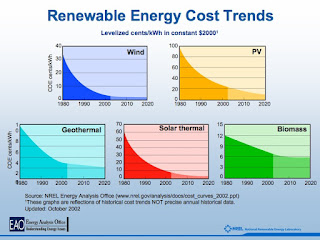
    The standard refrain from opponents of renewable energy is that it is expensive and too variable for a stable grid. These arguments have always been exaggerated, so several European countries have high RES penetration without serious problems. But now the arguments against RES have an obviously expiring shelve life. They have simply been out-paced by technological and economic developments.     The latest news comes from a new January 2018 report by the International Renewable Energy Agency (IRENA).  Their conclusions : Renewable power generation costs continue to fall and are already very competitive to meet needs for new capacity. Competitive procurement – including auctions – accounts for a small fraction of global renewable energy deployment. Yet these mechanisms are very rapidly driving down costs in new markets.. Global competition is helping to spread the best project development practices, reducing technology and project risk and making r...